Handloom or powerloom? A friendly guide to what you're really buying
How to tell them apart, what each fabric feels like, the weave patterns worth knowing, and how to care for and style your sarees every day.
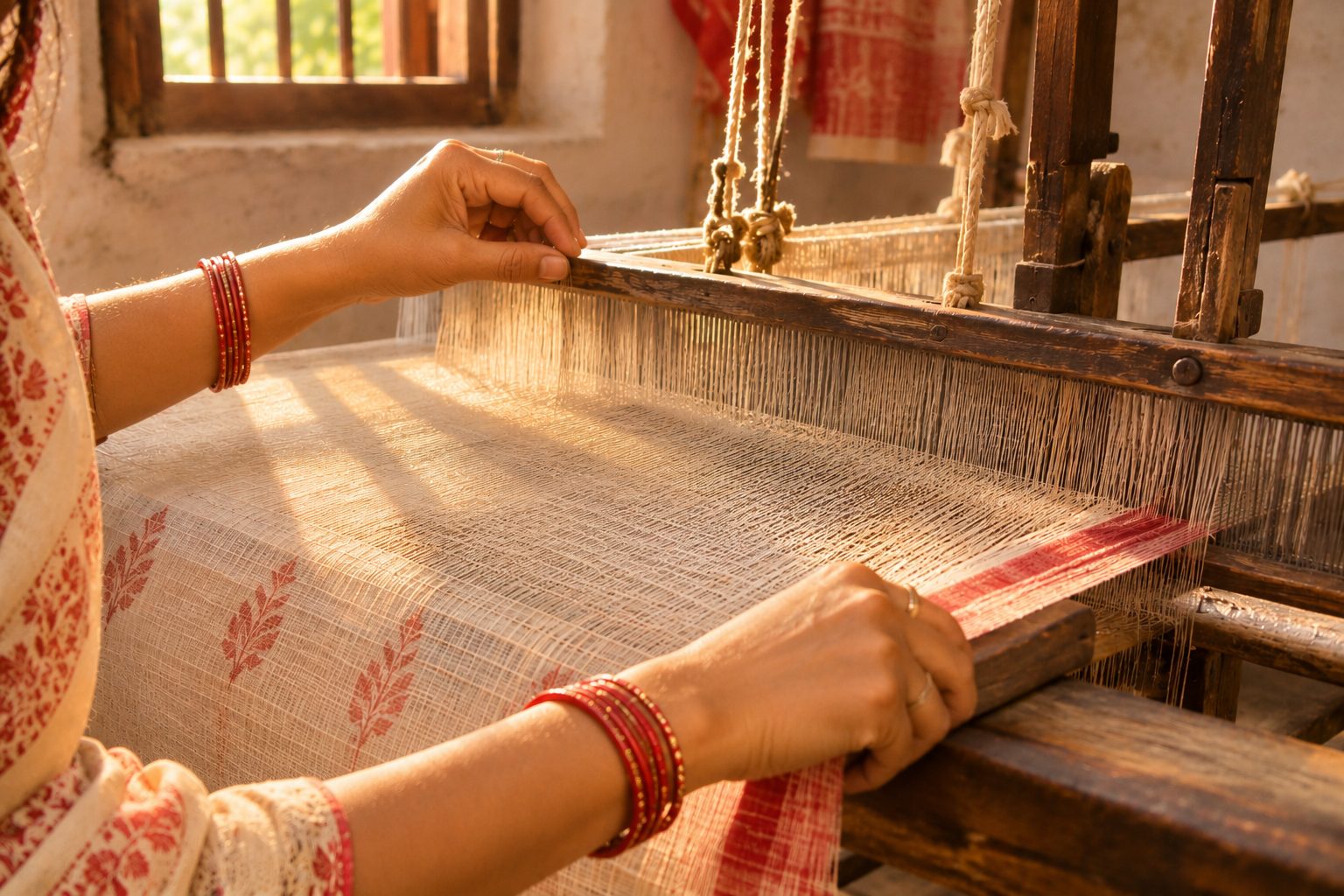
"This one is pure handloom." If you've heard that at a saree counter and wondered how you'd ever know, this guide is for you. Here is what handloom and powerloom really mean, how to tell them apart with your own eyes and fingers, what different fabrics feel like, and how to care for and wear them every day.
The short version
A handloom is a loom worked entirely by a person. The weaver lifts the warp threads with foot pedals, throws the shuttle across by hand and beats each row into place. There's no motor anywhere. Depending on the design, one saree can take anything from a few days to several weeks.
A powerloom is a loom driven by a motor. The weaving itself is mechanical, so it's much faster, every metre comes out the same, and the fabric costs less.
Here's the part people often miss: both can use the same yarns, the same colours and even similar designs. A powerloom saree isn't "fake". It becomes a problem only when it is sold as handloom.
| Handloom | Powerloom | |
|---|---|---|
| Who does the work | A weaver, by hand and foot | A motor-driven machine |
| Time per saree | Days to weeks | Hours |
| Look | Tiny variations; every piece is slightly different | Perfectly even, piece after piece |
| Feel | Softer and airier; often softens further with washing | Smoother and flatter |
| Price | Higher: you're paying for days of skilled work | More affordable |
How to tell them apart
You don't need a lab. A little detective work goes a long way.
- Check the edges. The long edges of the fabric (the selvedge) on a handloom piece are rarely machine-straight. You may even spot tiny pin holes along them, left by the stretcher weavers use to keep the width even. Powerloom edges tend to be dead straight and identical.
- Hold it up to the light. Handwoven fabric shows small, natural variations: a row packed a little tighter here, a little looser there. Powerloom fabric looks as regular as graph paper.
- Turn it over. The back of a handwoven piece shows the weaver's handwork: small knots, hand-trimmed threads behind motifs, the odd joined yarn. In weaves like Tangaliya, the pattern shows on both sides.
- Feel it. Handloom yarn isn't pulled as tight as it is on a machine, so the cloth usually feels softer and breathes better. Many handloom cottons get even softer with every wash.
- Think about the price. If a "pure handloom" Kota Doria costs the same as a powerloom one, ask why. Days of skilled work can't cost nothing.
- Just ask. A good seller will tell you straight away. At NavTana, every piece is labelled handloom or powerloom on its page, and if you'd like close-up photos of the weave, the edge or the back, we're happy to send them.
Small irregularities in a handwoven saree aren't flaws. They're the fingerprints of the person who made it.
So which one should you buy?
Honestly? It depends on what you want the saree for, and that's exactly why we carry both.
Choose handloom when you want something to keep: a saree that feels special on the skin, carries a living craft, and puts money directly behind a weaving family's skill. It's the one you'll pass on.
Choose powerloom when you want an easy, affordable saree for regular wear: office days, travel, summer afternoons, or a design you love at a price that lets you actually wear it often.
What matters is knowing which one you're buying, and paying a fair price for it.
Fabrics, and how they feel
The weave is only half the story. The fibre decides how a saree drapes, breathes and ages. Here are the ones you'll meet most often with us.
Kota Doria
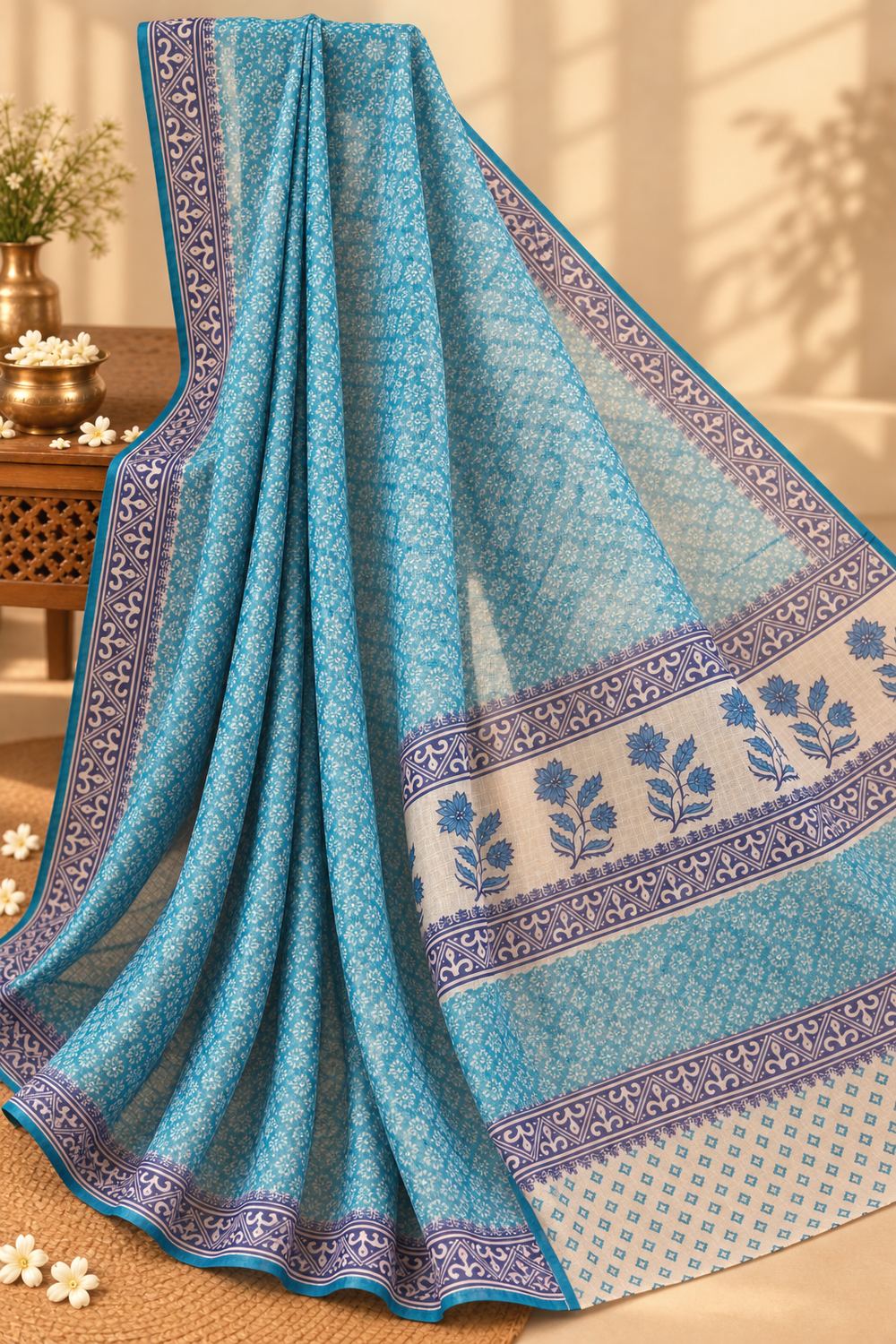
Woven from cotton and silk in tiny square checks called khat, Kota Doria is so light you'll forget you're wearing it. It's sheer, crisp and wonderfully cool, made for Indian summers. Silk-rich versions have a soft shine; cotton-rich ones feel more matte and relaxed. More about Kota Doria.
Tangaliya cotton
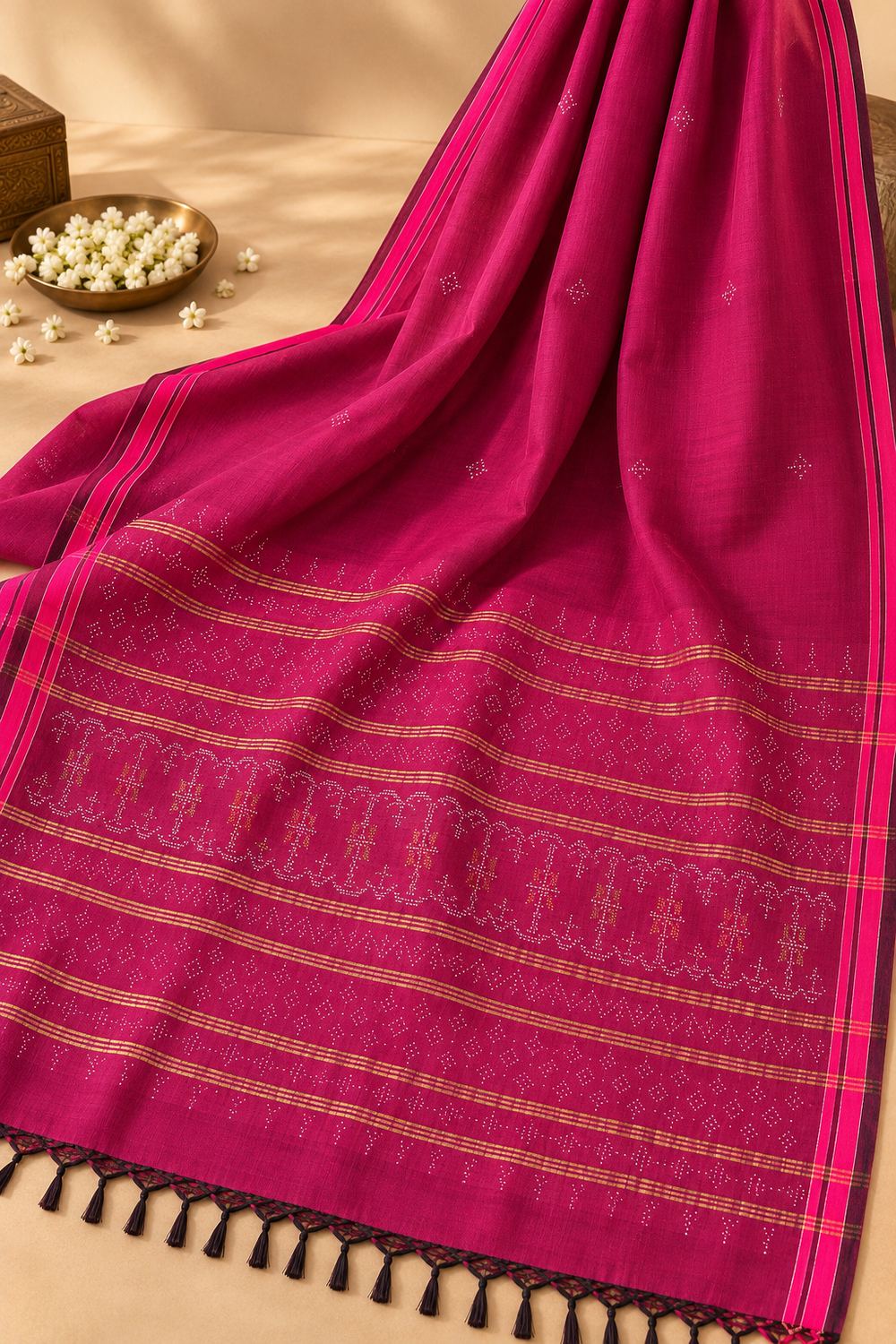
A soft, medium-weight cotton with rows of raised dots woven in by hand. It holds its shape beautifully, which is why it works so well for kurtas, suits and dupattas as well as sarees. More about Tangaliya.
Tussar and kosa silk
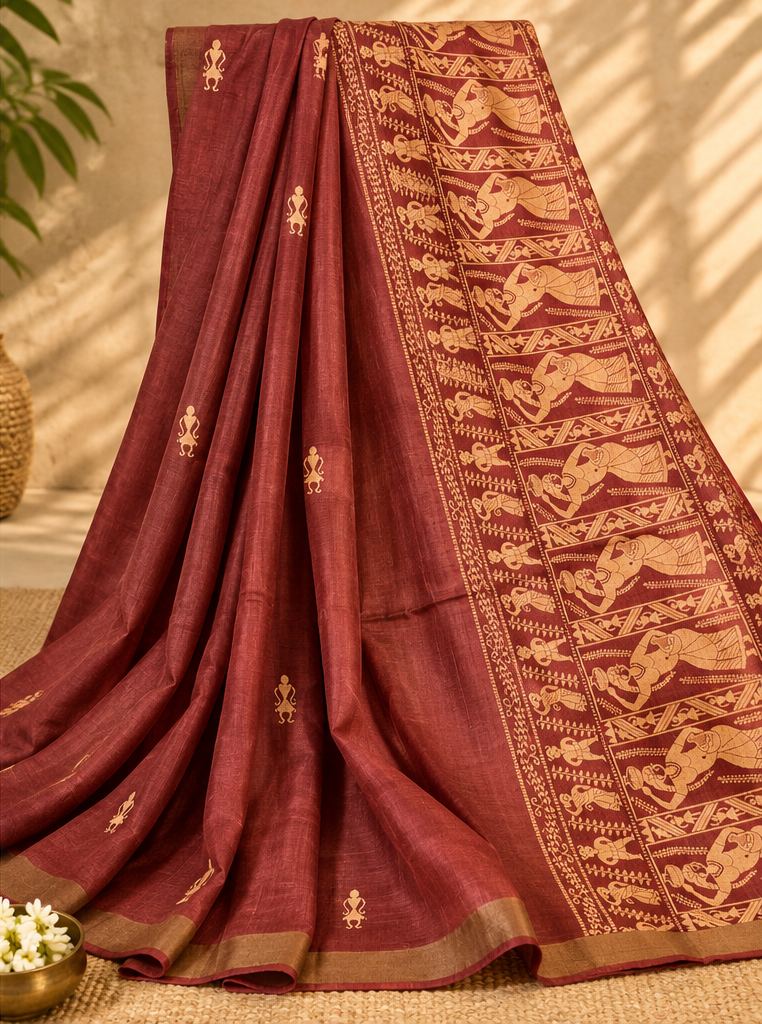
A wild silk with a natural golden glow and a gently uneven, textured surface. It's less slippery than mulberry silk, holds pleats well and feels comfortable for long days. Those little slubs in the yarn are part of its charm. More about our Bastar silks.
Tissue
Woven with metallic zari yarn, tissue has a soft shimmer and a crisp hand. It's our go-to for festive evenings when you want sparkle without heavy embroidery.
Linen and linen blends
Cool, breathable and relaxed. Linen creases, and that's the point: it gives an easy, lived-in elegance.
Block-printed cotton
Soft, breathable cotton printed by hand with carved wooden blocks, like the Bagru prints of Rajasthan. Look closely and you'll see the tiny joins where one block meets the next: proof a person did it.
Weave patterns worth knowing
Once you know these names, you'll start spotting them everywhere.
- Khat: the small square checks of Kota Doria, made by grouping cotton and silk threads in both directions.
- Daana: the raised dots of Tangaliya, each one twisted into the warp by the weaver's fingertips.
- Booti (buti): small motifs, such as flowers, leaves or paisleys, scattered across the body of the saree.
- Jaal: a net or trellis of motifs that covers the whole body, like a fine lattice.
- Extra-weft motifs: an extra thread laid in by hand only where the design needs it. Jamdani, Bastar tribal figures and Dola Bedi motifs are all made this way.
- Zari borders and pallus: metallic thread woven into the border or the pallu for richness.
And a few that people often call weaves but aren't: lehriya and bandhani are tie-dye techniques, block printing is printed on after weaving, and embroidery is stitched on top. That's why a single saree can be, say, powerloom Kota Doria with hand block printing, and why we list the weave and the technique separately on every piece.
Caring for your sarees
Good fabric rewards a little gentleness. The basics:
- First wash: dry clean silks, tissue and anything with zari or heavy colour. Many cottons can be gently hand washed from the start.
- Washing: cold water and a mild liquid detergent. Swish, don't scrub, and don't leave it soaking for long.
- Never wring. Roll the saree in a towel to press the water out.
- Dry in the shade, ideally inside out, so colours stay bright.
- Iron on the reverse, on a low setting for silk. A light starch brings back Kota Doria's crispness.
- Store it in cotton or muslin, never plastic, and refold every few months so the folds (especially zari ones) don't set into permanent lines.
Every fabric has its own quirks, so we've written a full care guide covering washing, drying, ironing and storage weave by weave.
Everyday styling
Heritage weaves were never meant to sit in a cupboard waiting for a wedding. A few easy ways to wear them more often:
- For the office: a muted Kota Doria or block-printed cotton with a fitted cotton blouse, a simple watch and flats or block heels. Pin the pleats and pallu so you can move freely all day.
- The shirt trick: swap the blouse for a crisp white or denim shirt, sleeves rolled. It works especially well with Tangaliya and tussar.
- Weekend and summer: light cotton or Kota Doria with a sleeveless blouse, kolhapuris and a cotton tote. Breezy and effortless.
- Dupattas, everywhere: a Tangaliya dupatta lifts a plain kurta instantly, and looks just as good over a white tee and jeans.
- Festive without fuss: tissue or a zari-bordered Kota with statement earrings, and skip the heavy necklace. Let the fabric do the talking.
- For men: Tangaliya kurta fabric makes a beautiful straight kurta. Wear it with white pyjamas for occasions, or jeans for everything else.
- Draping tip: featherlight Kota Doria likes a few extra safety pins; tussar holds its pleats on its own.
Still not sure whether a piece is right for you? Send us a message and we'll share close-ups, help with sizing a blouse, or suggest something similar. That's what we're here for.